Diversification Series Blog 2: Don’t Let One Funder Hold All the Power
By Heart for the Community Consulting
In our last blog, we talked about why funding diversification matters—especially now, with shrinking federal dollars. Less than a year into the Trump administration’s second term, many nonprofits are waking up to a harsh reality: the government funding they once relied on isn’t seeking to expand support, it’s disappearing entirely.
Federal grants that once powered everything from public media to social services have been frozen, slashed, or outright canceled. For example:
- AmeriCorps — the administration slashed nearly $400 million in active grants, threatening over 1,000 programs nationwide and putting vital community service efforts at risk (PBS NewsHour).
- National CASA/GAL Association for Children, which supports court-appointed volunteers for abused children, lost millions in federal funding—forcing programs to pause operations (The Imprint).
- U.S. foreign aid & development programs faced a 90-day freeze, cutting off money to refugee camps, disease prevention programs, and global humanitarian services (Wikipedia: Executive Order 14169).
Unfortunately, this isn’t just an American story—it’s a global pattern. Governments tighten belts, shift priorities, or wield funding as a political weapon. In the U.K., austerity measures after 2008 slashed billions from community organizations. In Brazil, NGOs saw massive losses when political leadership shifted funding away from civil society. And during the Cold War, U.S. foreign aid to nonprofits abroad swung wildly depending on which party held office.
The lesson? Nonprofits that survive—and thrive—are the ones that diversify. They don’t rely on one partner (or government) to sustain them. They build a web of support: foundations, individuals, corporations, and earned income.
So yes—it’s rough. But this blog isn’t just about laying out the crisis. It’s a guide to help you think through how you can thrive despite being ghosted, locked out, or sidelined by one funder. Think of it as building a stronger, healthier support circle that can carry you through—even when your biggest partner vanishes.
Step 1: Do a “Relationship Inventory”
Think of your funding sources like your social life. If you’re texting one person 95% of the time, and they suddenly stop replying… then you realize Ben & Jerry’s are your new best friend!
Action step: Do an honest check-in by writing down ALL of your revenue streams:
Please note: This list is not exhaustive and you may define some of these streams differently. The point is to note the diversity, no matter how you label it.
- Government grants (federal, state, and county)
- Government contracts
- Foundations (private and corporate grants)
- Corporate giving (sponsorships, not grants, if applicable)
- Individual donors (monthly givers, major gifts)
- Events (galas, golf tournaments, phone-a-thons, etc.)
- Fee for Service (i.e., a mentoring organization that sells its curriculum or trains organizations in its methodology)
- Federated giving (United Way, CFC)
- Other (i.e. membership dues, merch, peer-to-peer, crowdfunding)
Step 2: What Healthy Funding Looks Like
Next, calculate the percentages. If one “relationship” is more than 50% of your budget, 🚩 that’s a red flag.
Most experts agree: your nonprofit is stronger when no single funding source makes up more than 25–30% of your budget.
According to the Independent Sector’s 2024 annual review of the Health of the U.S. Nonprofit Sector, in 2022 nonprofit sources of revenue included:
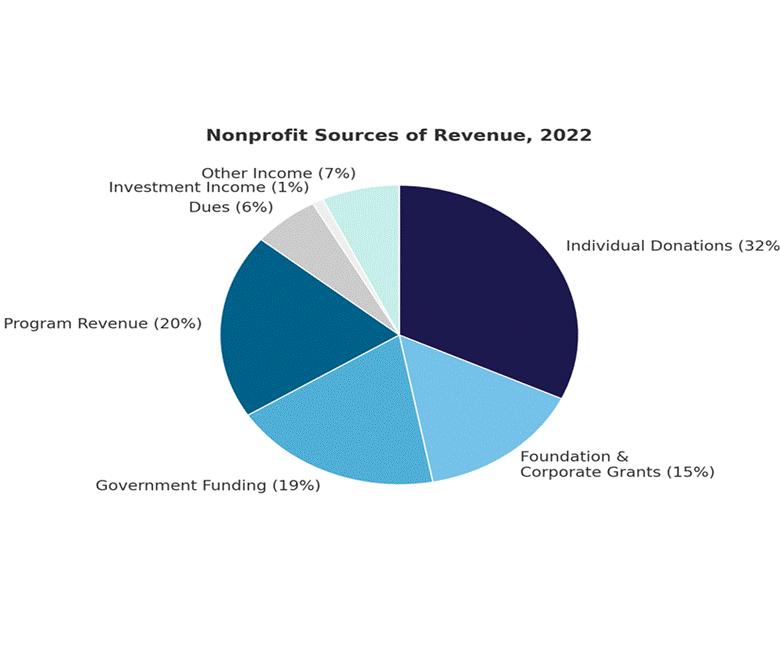
**Please note: Not all these categories will necessarily apply to your nonprofit.
Health of the U.S. Nonprofit Sector
Notice how no one funder is carrying the whole relationship. It’s like a well-rounded social circle – you’ve got your ride-or-die besties, your dependable family members, your fun coworkers, and even that friend who’s always down for karaoke. If one cancels on you? You’re still good.
Step 3: Spot Your Red Flags (Including the Hidden Ones)
As you develop your percentages, here are some things to look out for in your funding relationships:
🚩 Overdependence: One partner covers more than 30–40% of your budget.
🚩 Short-term flings: Grants or funders who are only in your life for a year.
🚩 Restricted funds: Money that can only be spent on specific programs (great, but doesn’t keep the lights on).
🚩 Mixed signals: Funders with shifting priorities.
Step 4: Do a Quick Relationship Check-In
Ask yourself:
- If my biggest donor disappeared tomorrow, could we survive 6 months?
- Do we rely on one gala or campaign for more than 20% of our budget?
- Do most of our donors give once and never again?
- Do we have at least one steady stream of “everyday love” (recurring gifts, earned income)?
Exploring the answers to these questions will allow you to see which pieces of the pie you need to grow in order to strengthen your fundraising program and begin to develop the necessary strategies.
Step 5: Don’t Sleep on the “Everyday Love”
$5 and $10 recurring donors don’t seem flashy, but they are the reliable friends who check on you, bring soup when you’re sick, and show up year after year. For small nonprofits, these steady, recurring gifts are one of the most underrated ways to build real resilience.
Food for Thought: Consider using Giving Tuesday as a way to grow this audience.
Final Thought
Developing a healthy funding mix takes work. It means diversifying your circle, balancing your energy, and not relying on one person (or one funder) to fill every need. Small nonprofits, especially, can’t afford risky, all-or-nothing relationships.
Take inventory. Build balance. Keep in touch with your “friends.” Because when your nonprofit is loved by many, you’re not just surviving—you’re thriving.